A holistic perspective from modern orthodontics
In holistic orthodontics (KFO360°), we don’t focus solely on teeth — we look at the entire person: breathing, musculature, posture, and functional patterns. One topic we encounter very frequently, and one that can trigger widespread problems within the masticatory system, is the wisdom teeth, also known as third molars.
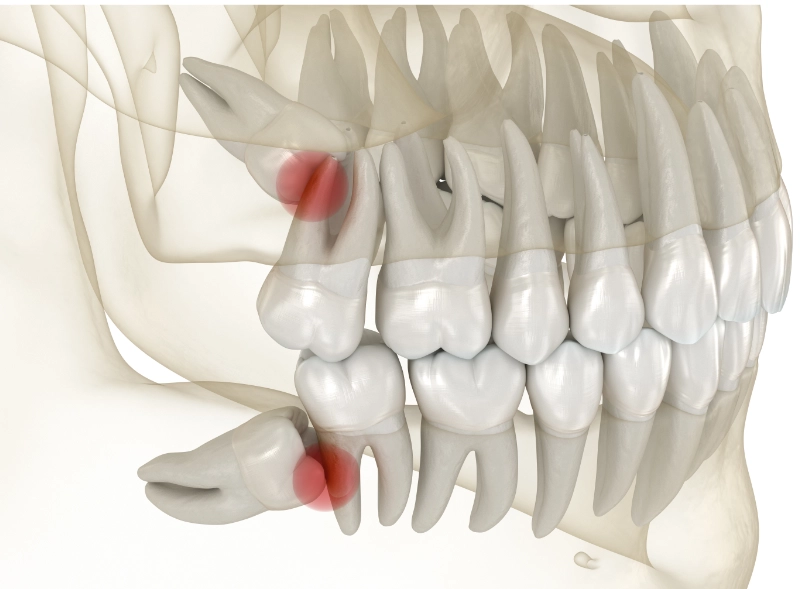
From an evolutionary perspective, the human jaw has become smaller over time, while the number of teeth has remained the same. As a result, there is often insufficient space for wisdom teeth in the modern dental arch. This is why they frequently fail to erupt properly and cause a range of issues.
In functional orthodontics and CMD diagnostics, wisdom teeth play a crucial role, as they can significantly affect the bite, the temporomandibular joints (TMJ), and even muscular tension throughout the body.
Why Wisdom Teeth Are Often Removed
1. Lack of Space – the most common reason
Due to reduced jaw size, wisdom teeth often do not have enough room to erupt correctly. As a result, they may:
- remain fully impacted in the bone
- erupt only partially
- tilt or rotate unfavorably
- exert pressure on the second molars
This can lead to malocclusion, crowding, and even negatively affect previously achieved orthodontic results.
What Happens When Wisdom Teeth Erupt?
When wisdom teeth erupt, they can cause:
Premature contacts in the bite
Even a single premature contact can disrupt the finely tuned relationship between the upper and lower jaw. This may result in:
- dysfunction of the temporomandibular joint
- clicking or popping sounds
- neck and masticatory muscle tension
- headaches or migraines
- CMD-like symptoms
In practices that work with digital functional analysis, T-Scan measurements, bite analysis, Modjaw, and digital occlusal fine-tuning, these correlations are observed on a daily basis.
When Wisdom Teeth Do Not Erupt
Impacted wisdom teeth can cause serious and often unexpected problems later in life:
1. Increasing risk of nerve injury with age
Over time, the roots of wisdom teeth continue to grow and may wrap around the inferior alveolar nerve. If extraction is delayed until the 30s, 40s, or later, the risk of:
- numbness
- sensory disturbances
- permanent nerve damage
increases significantly.
For this reason, removal is often recommended between the ages of 16 and 18, when root development is still incomplete.
2. Infections and abscesses in the jawbone
Even fully impacted wisdom teeth may have small communication pathways to the oral cavity. Bacteria can enter and cause:
- chronic inflammation
- abscess formation
- hidden caries within the bone
If left untreated, these infections can spread rapidly.
3. Damage to adjacent teeth
Wisdom teeth are often located very close to the second molars and may:
- push neighboring teeth out of position
- damage their roots
- create periodontal pockets and bone loss
- cause decay on adjacent teeth
4. Increased risk of mandibular fractures later in life
In older age, retained wisdom teeth can create a structural weak point in the angle of the mandible. In the event of a fall, the jaw is more likely to fracture in this area.
Wisdom Teeth During Orthodontic Treatment
If orthodontic treatment is planned or already in progress, it is often advisable to remove wisdom teeth earlier, especially if they interfere with tooth movement or alter the bite.
While the surgical procedure may be slightly more complex at that time, orthodontic treatment usually becomes faster, more predictable, and more stable afterward.
With the support of modern technology such as:
- 3D imaging (CBCT/DVT)
- digital intraoral scans
- T-Scan bite analysis
- Modjaw functional diagnostics
- digital bite planning
- treatment simulations
- 3D printing
wisdom tooth removal today can be planned more precisely and safely than ever before.
Holistic Orthodontics & Wisdom Teeth – Why They Belong Together
In our practice, we combine advanced diagnostics with a holistic understanding of:
- breathing
- jaw development
- tongue function
- myofunctional therapy
- CMD analysis
- head and body posture
Wisdom teeth often play a key role within this functional system. Therefore, evaluation of the third molars is an integral part of our KFO360° diagnostic approach.
When Should Wisdom Teeth Be Removed? – Our Conclusion
Removal is usually recommended when:
✔ there is insufficient space
✔ the teeth are tilted or impacted
✔ pain is present
✔ CMD symptoms exist
✔ inflammation or abscesses develop
✔ adjacent molars are at risk
✔ roots approach the nerve
✔ orthodontic treatment is planned
The earlier wisdom teeth are evaluated, the safer, gentler, and more predictable their removal tends to be.